
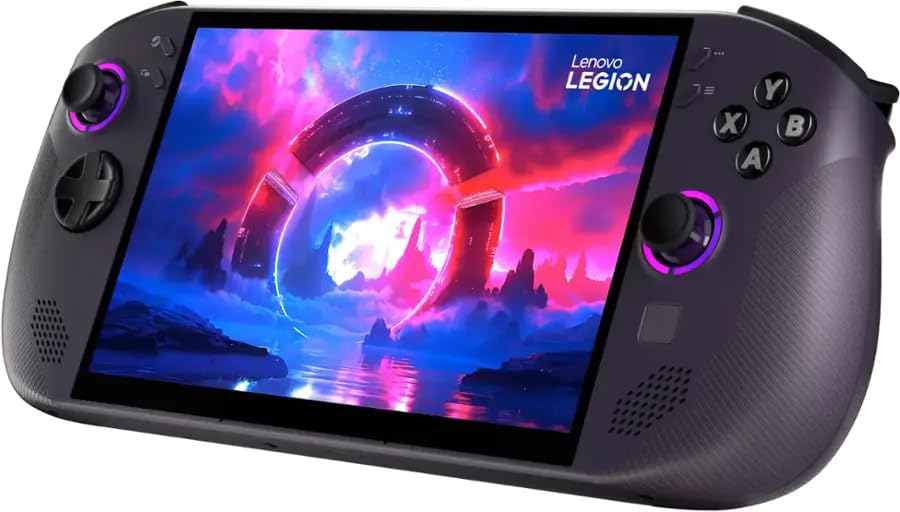
Lenovo Legion Go S (Z1 Extreme) Review: The Handheld That Finally Feels Right in Your Hands
This post contains affiliate links. If you purchase through these links, I may earn a small commission at no extra cost to you. This helps support the site and allows me to continue creating honest reviews like this one. All opinions are my own.
Let me get this out of the way: the handheld gaming PC market is a mess right now. You've got the Steam Deck sitting comfortably as the default recommendation, the ROG Ally X flexing its battery life, and a dozen pretenders launching every quarter. So when Lenovo dropped the Legion Go S as a smaller, lighter successor to the original Legion Go, my first reaction was "do we really need another one?" After spending serious time with the Z1 Extreme model, my answer is a qualified yes — because this thing nails the one thing most handhelds get wrong: how it actually feels to hold for hours at a time.
The Legion Go S isn't trying to be the most powerful handheld on the market. It's trying to be the one you'll actually enjoy using during a four-hour gaming session without your hands cramping up. And with the Ryzen Z1 Extreme under the hood (not the weaker Z2 Go in the budget model — avoid that one), it has enough muscle to back up those ergonomic ambitions. Let's dig in.
Quick Specs
| Spec | Detail |
|---|---|
| Price | ~$980 MSRP (frequently ~$830 on sale) |
| Processor | AMD Ryzen Z1 Extreme (8 cores/16 threads, up to 5.1 GHz) |
| GPU | AMD Radeon 780M (RDNA 3, 12 CUs, up to 2.7 GHz) |
| RAM | 32GB LPDDR5X-7500 |
| Storage | 1TB NVMe SSD (M.2 2242) + microSD slot |
| Display | 8" IPS LCD, 1920×1200, 120Hz, VRR, 500 nits, touchscreen |
| Battery | 55.5 Wh, 65W USB-C charging |
| Weight | 1.61 lbs (730g) |
| Dimensions | 11.77 × 5.02 × 0.89 inches |
| OS | Windows 11 Home (SteamOS version also available) |
| Connectivity | Wi-Fi 6E, Bluetooth 5.3 |
| Ports | 2× USB-C 4.0 (DP out), 3.5mm audio, microSD |
| Controls | Hall Effect thumbsticks, gyro, haptics, trigger locks, trackpad, 2 rear buttons |
| Warranty | 1 year standard |
What Makes This Handheld Stand Out
The Best Ergonomics in the Business
I'm going to keep coming back to this because it's genuinely the Legion Go S's killer feature. The curved grips, the way the rear contours cradle your pinky fingers, the balanced weight distribution — Lenovo clearly studied how people actually hold these devices for extended periods. Multiple reviewers have called it the most comfortable handheld they've used, and I understand why. If you've ever felt hand fatigue with a Steam Deck after an hour, this is the antidote. The offset thumbsticks (Xbox layout) with RGB rings are responsive, and the adjustable trigger locks are a nice touch for shooters.
Z1 Extreme Changes Everything
Here's the critical distinction: the Legion Go S comes in two processor configurations, and they're worlds apart. The budget Z2 Go model (which most early reviews covered) is frankly disappointing — it struggles to hit 30fps in demanding games and reviewers universally said "just buy a Steam Deck instead." The Z1 Extreme model is a completely different animal. This is the same chip that powers the ROG Ally and the original Legion Go — 8 cores, RDNA 3 graphics, and enough horsepower to run most AAA titles at playable frame rates. Resident Evil 4 above 80fps on high settings? That's Z1 Extreme territory. Don't confuse the two models — the Z1 Extreme is the one worth buying.
32GB RAM Is the Sweet Spot
While 16GB has been the standard for handhelds, the Legion Go S Z1 Extreme ships with 32GB of fast LPDDR5X. This isn't just a spec sheet flex — users consistently report fewer stutters, smoother shader compilation, and better multitasking (especially if you're running Windows with background apps). It's the kind of upgrade you feel in practice, not just in benchmarks.
That 8-Inch Display Hits Different
The 8-inch, 1920×1200 IPS panel at 120Hz with VRR support is a real sweet spot. It's larger than the Steam Deck's 7.4-inch and the ROG Ally's 7-inch screens, giving you more visual real estate without making the device unwieldy. At 500 nits with good color coverage (about 85% DCI-P3, 120% sRGB), it's bright and vivid even if it's not OLED. The auto-brightness sensor is a small but appreciated inclusion.
The Pros
- Best-in-class ergonomics — Curved grips, balanced weight, and a chassis designed for marathon sessions. Nothing else in the market feels this good for extended play.
- Z1 Extreme delivers real performance — Same proven chip as the ROG Ally, with enough power for AAA gaming at 800p–1200p with reasonable settings.
- 32GB RAM eliminates stutters — Noticeably smoother gameplay and multitasking compared to 16GB handhelds.
- Large, bright 8-inch display — 120Hz VRR, 500 nits, and great color accuracy make games look fantastic.
- Hall Effect thumbsticks — No drift concerns, with smooth analog response and satisfying RGB accents.
- Dual USB-C 4.0 ports — Both support DisplayPort out, so you can charge and dock simultaneously without a hub.
- Upgradeable SSD — The M.2 slot accepts both 2242 and 2280 drives, so storage upgrades are straightforward.
- Gyro controls and haptics — HD haptics and 6-axis gyro add precision aiming options, especially useful in shooters.
The Cons
- Battery life is mediocre — The 55.5Wh battery delivers roughly 1.5–2 hours of actual gaming. That's worse than the ROG Ally X (80Wh) and about on par with the Steam Deck OLED. Plan on being near an outlet.
- Windows 11 is a pain on a handheld — Touch targets are tiny, the on-screen keyboard is unreliable, and you'll constantly fight with display scaling. Lenovo's Legion Space launcher helps, but it's no substitute for SteamOS. Consider installing SteamOS if you're comfortable with it.
- Expensive for what you get — At ~$980 MSRP, it's pricier than the ROG Ally X ($799) which has a bigger battery and comparable performance. Sale prices around $830 make it more competitive.
- All-plastic build — No metal anywhere in the chassis. It feels solid enough, but at nearly $1,000 you expect more premium materials.
- No detachable controllers — The original Legion Go's party trick was Switch-style detachable controllers. The Go S drops this entirely.
- No kickstand — Another casualty of the slimmed-down design. You'll need a separate stand for tabletop play.
- Trackpad is finicky — Clicks can cause cursor drift in games, and the force feedback vibrates the whole unit until you manually disable it.
- Legion Space software is half-baked — It categorizes all apps as games, offers limited customization, and VRAM allocation sometimes requires manual BIOS changes.
Who Should Buy This
If you game on the go regularly — commutes, travel, lunch breaks — and hand comfort is a priority, this is your handheld. The Z1 Extreme model strikes a strong balance between power and portability, and the 32GB of RAM future-proofs it against increasingly demanding titles. It's also an excellent pick if you already have a gaming PC or console at home and want a companion device for lighter sessions, indie games, and emulation. The dual USB-C ports make docking for a desktop-style experience dead simple. Catch it at the $830 sale price and it becomes a genuinely competitive option.
Who Should Look Elsewhere
If battery life is your top priority, the ASUS ROG Ally X ($799) packs an 80Wh battery that'll give you 40–50% more playtime — and it costs less. If you want the best handheld gaming experience per dollar and don't mind Linux, the Steam Deck OLED 1TB ($649) is still the default recommendation — the OLED display is gorgeous, SteamOS is purpose-built for handheld use, and the ecosystem is unmatched. And if you see the Legion Go S with the Z2 Go chip at a lower price, keep walking — the performance gap is massive and reviewers unanimously agree it's not worth it at any price. Gamers who loved the original Legion Go's detachable controllers and kickstand won't find those here either.
The Competition
| Feature | Legion Go S (Z1 Extreme) | ASUS ROG Ally X | Steam Deck OLED 1TB | MSI Claw 8 AI+ |
|---|---|---|---|---|
| Price | ~$799 | ~$649 | ~$899 | |
| Processor | Ryzen Z1 Extreme | Ryzen Z1 Extreme | Custom AMD APU | Core Ultra 7 258V |
| RAM | 32GB LPDDR5X | 24GB LPDDR5X | 16GB LPDDR5 | 32GB LPDDR5X |
| Display | 8" IPS, 120Hz, 500 nits | 7" IPS, 120Hz, 500 nits | 7.4" OLED, 90Hz, 1000 nits | 8" IPS, 120Hz, 500 nits |
| Battery | 55.5 Wh | 80 Wh | 50 Wh | 80 Wh |
| Storage | 1TB NVMe | 1TB NVMe | 1TB NVMe | 1TB NVMe |
| Weight | 1.61 lbs | 1.54 lbs | 1.41 lbs | 1.65 lbs |
| OS | Windows 11 | Windows 11 | SteamOS | Windows 11 |
| Best For | Comfort + power | Battery life + value | Ecosystem + display | Raw performance |
The Verdict
The Lenovo Legion Go S with the Z1 Extreme is a tale of two stories. On one hand, it's the most comfortable gaming handheld you can buy, with a display that's larger and brighter than most of the competition, and enough horsepower to handle real gaming — not just indie titles and emulators. The 32GB of RAM is a genuine advantage that you'll feel in daily use. On the other hand, it's overpriced at MSRP, the battery will leave you tethered to outlets more than you'd like, and Windows 11 continues to be a frustrating handheld operating system that Lenovo's software layer only partially masks.
Here's the honest calculus: at $830 on sale with the Z1 Extreme chip, it's a compelling buy for anyone who prioritizes comfort and has access to power outlets. At $980 MSRP, the ROG Ally X is the smarter purchase — it's cheaper, has a significantly better battery, and offers comparable performance. And if you don't need Windows, the Steam Deck OLED remains the best overall value in handheld gaming, period.
The Z1 Extreme Legion Go S earns its keep by being the handheld you'll actually want to hold. In a market full of capable-but-cramped devices, that counts for more than you'd think.
Rating: 4/5 — Exceptional ergonomics and solid Z1 Extreme performance, held back by a steep price tag and underwhelming battery life. A strong buy on sale.
Deal Tip 💡 The Z1 Extreme model regularly drops from its ~$980 MSRP to around $830 during sales events. That $150 savings closes the gap with the ROG Ally X and makes it much easier to recommend. Also watch for the SteamOS version — same hardware, better handheld experience, and typically priced lower. Whatever you do, make sure you're getting the Z1 Extreme model (not the Z2 Go) — the performance difference is night and day.
The Verdict
The Z1 Extreme version of Lenovo's slimmed-down handheld delivers real gaming power in the most comfortable chassis you can buy — if you can live with the battery life. Worth buying if it fits how you'll actually use it.
This post contains affiliate links. If you buy through one, I may earn a commission at no extra cost to you.