
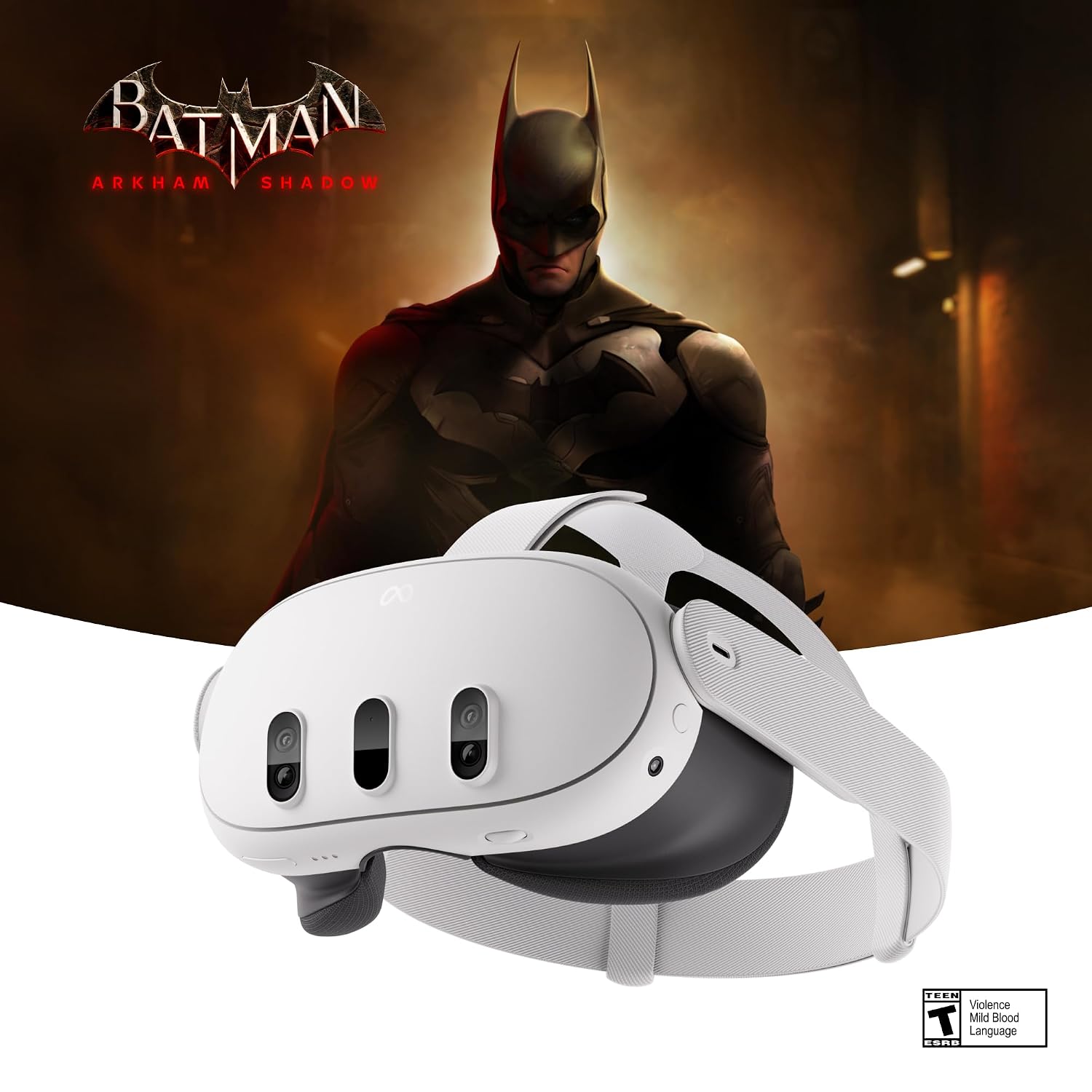
Meta Quest 3 512GB Review: The VR Headset That Finally Makes Mixed Reality Real
This post contains affiliate links. If you purchase through these links, I may earn a small commission at no extra cost to you. This helps support the site and allows me to continue creating honest reviews like this one. All opinions are my own.
I'll admit it — I was late to VR. I always thought it was one of those tech categories that was perpetually "almost there." Cool demos, clunky hardware, and a game library that felt more like a tech showcase than something you'd actually use every week. But the Meta Quest 3 changed my mind. This is the headset that makes VR feel like a real entertainment platform, not a science experiment.
The 512GB model specifically is the one I want to talk about, because storage matters more than most people realize in VR. Games are big. Updates are bigger. And when you're deleting a 15GB title to make room for the latest release, the magic disappears fast. At 512GB, that problem goes away entirely.
But at $499, it's not cheap. So let's break down whether the Quest 3 512GB actually delivers on the promise — or whether you should save $200 and get the Quest 3S instead.
Quick Specs
| Feature | Details |
|---|---|
| Processor | Qualcomm Snapdragon XR2 Gen 2 |
| RAM | 8GB |
| Storage | 512GB |
| Display | Dual LCD, 2,064 x 2,208 per eye (4K+ Infinite Display) |
| PPI | 1,218 PPI (~25 pixels per degree) |
| Refresh Rate | 90Hz (120Hz experimental) |
| Lenses | Pancake lenses |
| Field of View | ~110° horizontal |
| Passthrough | Full-color RGB + depth sensor |
| Weight | 515g (~1.1 lbs) |
| Battery Life | ~2 hours (rated 2.2 hrs) |
| Controllers | Touch Plus (no tracking ring, TruTouch haptics) |
| Audio | Built-in spatial audio, 3.5mm jack |
| Connectivity | Wi-Fi 6E, Bluetooth 5.3, USB-C |
| IPD Adjustment | Continuous wheel (58–71mm) |
| PC VR | Yes (Link Cable or Air Link / Virtual Desktop) |
| Regular Price | $499 |
| Includes | Batman: Arkham Shadow + 3-month Meta Horizon+ trial |
What Makes the Quest 3 Stand Out
Pancake Lenses Change Everything
This is the single biggest upgrade over the Quest 2 and the biggest advantage over the cheaper Quest 3S. Pancake lenses are thinner, sharper edge-to-edge, and produce a wider sweet spot than the old Fresnel lenses. In practice, that means the image stays clear when you glance to the side instead of turning your whole head. The visor is 40% slimmer than the Quest 2, which makes the headset lighter on your face and more balanced.
The Quest 3S went back to Fresnel lenses to hit its $299 price point, and the difference is immediately noticeable. If visual quality matters to you — and in VR, it should — the Quest 3's pancake lenses are worth the upgrade.
True Mixed Reality With a Depth Sensor
The Quest 3 has a depth sensor that the Quest 3S doesn't. That means it can actually understand the 3D geometry of your room — not just overlay a camera feed, but map furniture, walls, and objects so virtual content can interact with your real space. Games like Starship Home turn your living room into an alien spaceship. First Encounters lets you shoot virtual aliens hiding behind your actual couch.
The full-color passthrough is also significantly better than the Quest 3S. At 18 pixels per degree, it's not perfect — you'll still struggle to read small text on your phone — but it's good enough to see your surroundings, grab a drink, or have a conversation without removing the headset.
512GB of Storage = No Compromises
This is why the 512GB model exists. VR games range from 2GB to 20GB+, and the Quest platform now has thousands of titles. With the 128GB Quest 3S, you're managing storage from day one. At 512GB, you can install your entire library and forget about it. No deleting, no re-downloading, no waiting for installs when you want to show a friend a game. If you're buying into VR as a long-term platform, this is the storage tier that makes sense.
The Game Library Is Finally Mature
The Quest platform has crossed the threshold from "interesting experiments" to a legitimate gaming library. Batman: Arkham Shadow (included free), Assassin's Creed Nexus, Asgard's Wrath 2, Resident Evil 4 VR, Beat Saber, Walkabout Mini Golf — these are real, full-length games. And everything from the 500+ Quest 2 library runs on the Quest 3, often with enhanced graphics.
You can also connect to a gaming PC via Link Cable or wirelessly through Air Link for PC VR titles, opening up SteamVR and the entire PC VR ecosystem.
The Pros
- Pancake lenses — dramatically sharper and clearer than Fresnel, with a wider sweet spot and slimmer visor
- Best standalone VR display — 2,064 x 2,208 per eye with vibrant LCD color; a visible step up from the Quest 3S and Quest 2
- 512GB storage — install everything, delete nothing; future-proof for years of VR content
- Full-color mixed reality with depth sensor — your room becomes the game environment, not just a passthrough feed
- Snapdragon XR2 Gen 2 — same chip as the Quest 3S, with double the GPU power of the Quest 2
- Touch Plus controllers — no tracking ring, TruTouch haptics, precise 6DoF tracking
- Continuous IPD adjustment — a real dial, not three fixed settings like the Quest 3S
- PC VR compatible — wired or wireless, opens up the full SteamVR library
- Mature game library — thousands of titles, including major franchise entries
- Built-in spatial audio — surprisingly good, loud enough to skip headphones for casual play
- Batman: Arkham Shadow included — one of the best VR games ever made, free in the box
The Cons
- Battery life is genuinely short — expect ~2 hours in demanding games. You'll want a battery head strap or a powerbank for longer sessions.
- Default head strap is mediocre — the cloth strap that ships in the box is flimsy, presses on the forehead, and causes headaches after 20–30 minutes for many users. Budget $30–$50 for an aftermarket elite strap.
- Headaches from pressure — the most common complaint across review sites. The front-heavy weight distribution without a counterbalance puts pressure on your forehead and cheekbones.
- Passthrough still isn't sharp enough for work — fine for awareness, but you can't comfortably read a book or use a laptop through it
- No OLED — the LCD panels deliver good color, but blacks are gray. Horror games and dark environments lose immersion compared to OLED headsets like the PSVR 2.
- Software freezes — some users report occasional system hangs requiring a hard restart
- Meta account required — you're in Meta's ecosystem, with their data collection policies
- Price premium over Quest 3S — the 3S runs the exact same games on the same chip for $200 less; the visual and comfort upgrades are real, but not everyone needs them
- Fragile strap arms — multiple reports of the headstrap arms cracking or breaking with normal use
Who Should Buy This
The Meta Quest 3 512GB is the right headset if you're going all-in on VR as a regular entertainment platform. If you plan to build a big game library, play PC VR, use mixed reality features for more than novelty, or you just want the best visual quality in a standalone headset — this is it. The pancake lenses, depth sensor, continuous IPD adjustment, and 512GB storage are all meaningful upgrades over the Quest 3S.
It's also the pick if you wear glasses (the adjustable facial interface works better than the 3S's fixed spacer) or if comfort is a priority — with an aftermarket strap, the Quest 3 is the more comfortable headset.
Who Should Look Elsewhere
If this is your first VR headset and you're not sure you'll use it regularly, the Quest 3S at $299 runs every single Quest 3 game on the same processor. You're giving up lens quality and FOV, but the savings are real. Test the water for $200 less.
If you're a PlayStation gamer and want the most immersive visual experience possible, the PSVR 2 ($399 on sale) has OLED displays that produce true blacks and better contrast. The trade-off is that it's wired and requires a PS5.
And if your primary interest is fitness — Beat Saber, Supernatural, boxing apps — the 2-hour battery life will frustrate you unless you invest in a battery strap. Consider that accessory cost in your budget.
The Competition
| Headset | Price | Display | Lenses | Storage | Battery | Standalone? |
|---|---|---|---|---|---|---|
| Meta Quest 3 512GB | $499 | 2,064x2,208/eye LCD | Pancake | 512GB | ~2 hrs | Yes |
| Meta Quest 3S 256GB | $399 | 1,832x1,920/eye LCD | Fresnel | 256GB | ~2.5 hrs | Yes |
| PSVR 2 | $399–$549 | 2,000x2,040/eye OLED | Fresnel | N/A (PS5) | Wired | No |
| Apple Vision Pro | $3,499 | Micro-OLED | Custom | 256GB–1TB | ~2 hrs | Yes |
The Quest 3 512GB sits in the sweet spot: better than the budget options, a fraction of the Apple Vision Pro's price, and standalone without a console tether.
The Verdict
The Meta Quest 3 512GB is the best standalone VR headset available right now. The pancake lenses, full-color mixed reality with a depth sensor, mature game library, and 512GB of storage make it the complete package for anyone serious about VR. It runs everything the Quest 3S runs, but looks better, fits better (with IPD adjustment), and has enough storage to never worry about space.
The real weaknesses are the 2-hour battery life and the terrible default head strap — both problems that cost extra to fix. And yes, Meta's data collection comes with the territory. But if you can live with those trade-offs, no other headset at any price under $3,500 gives you this combination of standalone freedom, visual quality, and content library.
If you've been waiting for VR to "get good enough" — it has. This is the one.
Rating: 4/5 — The most complete standalone VR headset on the market, held back by short battery life, a bad default strap, and the realities of Meta's ecosystem.
Deal Tip 💡
The Quest 3 512GB regularly drops to the $400–$450 range during Prime Day and holiday sales, sometimes with an additional $100 Amazon promo credit. At $499 it's solid; under $450 with a promo credit it's an exceptional deal. Whatever you do, budget $30–$50 for a third-party elite strap — it transforms the comfort from "tolerable" to "genuinely good."
The Verdict
The best standalone VR headset you can buy — pancake lenses, full-color mixed reality, and the Snapdragon XR2 Gen 2 chip. 512GB means you'll never delete a game to make room for another one. Worth buying if it fits how you'll actually use it.
This post contains affiliate links. If you buy through one, I may earn a commission at no extra cost to you.