
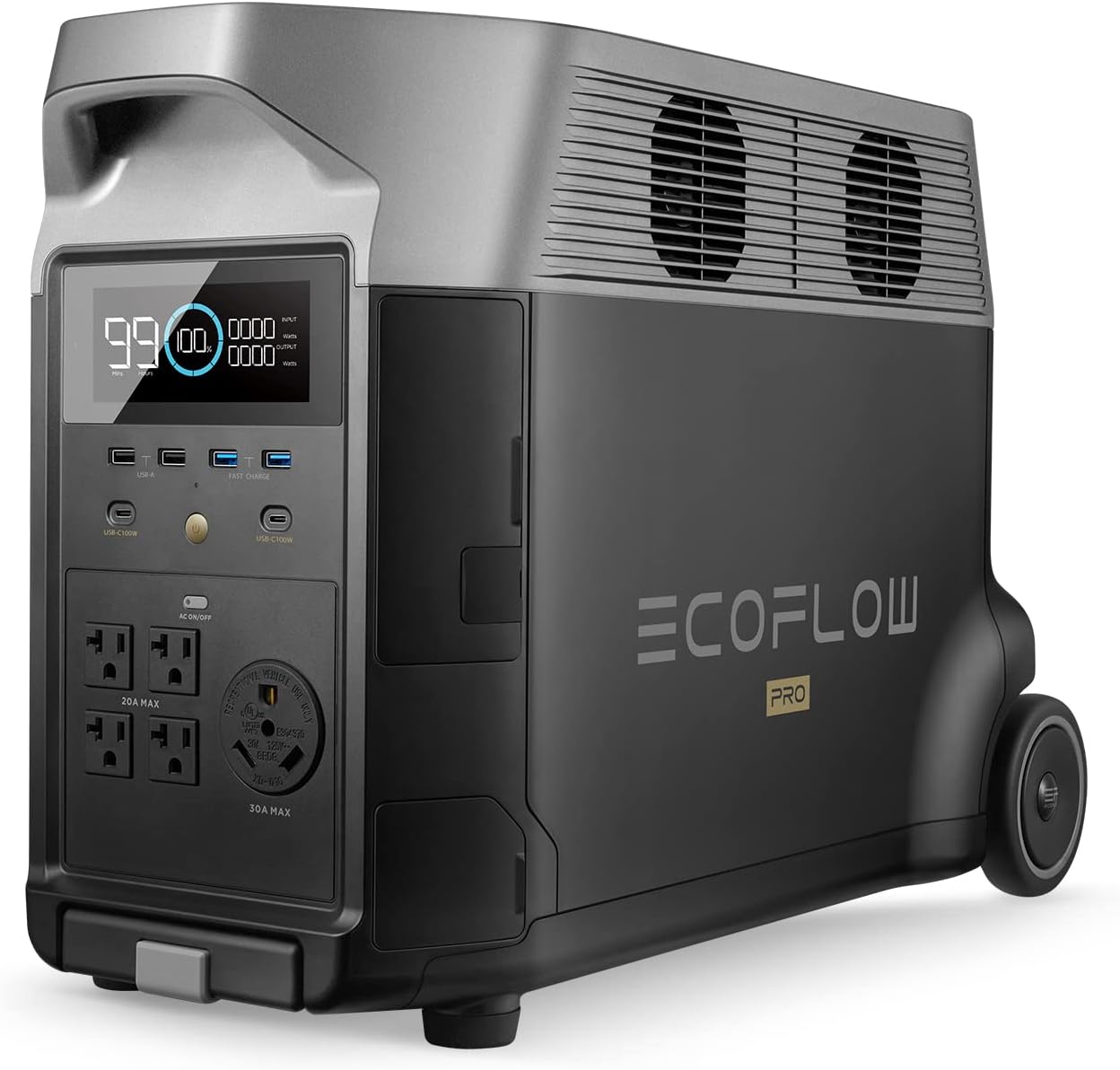
EcoFlow DELTA Pro Review: The Portable Power Station That Can Actually Run Your House
This post contains affiliate links. If you purchase through these links, I may earn a small commission at no extra cost to you. This helps support the site and allows me to continue creating honest reviews like this one. All opinions are my own.
I've been skeptical of portable power stations for years. Most of them are glorified phone chargers that slap "emergency backup" on the box but can barely keep a mini-fridge running for a few hours. The EcoFlow DELTA Pro is a different animal entirely. With 3,600Wh of LiFePO4 battery, a 3,600W pure sine wave inverter (7,200W surge), and an expandable ecosystem that scales all the way to 25kWh, this isn't a camping gadget — it's a legitimate home backup power system that happens to have wheels.
But "legitimate" comes with caveats. This thing weighs nearly 100 pounds. It costs more than some used generators. And the ecosystem add-ons that unlock its full potential can push the total investment well past $5,000. I dug into the specs, real-world reviews, and owner reports to figure out who actually needs this much portable power — and who's better off with something smaller, cheaper, or both.
Quick Specs
| Spec | Detail |
|---|---|
| Price | ~$2,000–$2,500 (originally $3,599 MSRP) |
| Battery | 3,600Wh LiFePO4 (LFP) |
| Cycle Life | 3,500 cycles to 80% capacity |
| Inverter Output | 3,600W continuous, 7,200W surge (pure sine wave) |
| Expandable | Up to 25kWh with extra batteries |
| AC Outlets | 5 total (4× 20A standard + 1× 30A RV/dryer) |
| USB Ports | 2× USB-C 100W, 2× USB-A fast-charge 18W, 2× USB-A 12W |
| DC Outputs | 2× DC5521 (38W each), car socket (126W), Anderson port (378W) |
| AC Charging | Up to 1,800W (~2–3 hours wall charge) |
| Solar Input | Up to 1,600W |
| Max Combined Input | Up to 6,500W (with EV adapter + solar + AC) |
| Display | 5-inch LCD touchscreen |
| Connectivity | Wi-Fi + Bluetooth, EcoFlow app |
| Weight | ~99 lbs |
| Dimensions | 25 × 11.2 × 16.4 inches |
| Warranty | 5 years |
What Makes This Power Station Stand Out
It Can Actually Power a House
This isn't marketing fluff. The DELTA Pro's 3,600W inverter handles refrigerators, window AC units, space heaters, microwaves, power tools, and most household appliances without blinking. The 30A RV outlet means you can plug directly into an RV or use EcoFlow's Smart Home Panel to wire it into your home's electrical panel — covering up to 10 circuits with an automatic switchover under 20 milliseconds. During a real power outage, this keeps your fridge, lights, internet, and medical devices running while your neighbors are lighting candles.
The Expandable Ecosystem Is Unmatched
Start with 3,600Wh. Add an extra DELTA Pro battery for 7,200Wh. Stack more for up to 25kWh — that's enough to power a small home for over 24 hours during an outage, or run essential circuits for days. The optional Double Voltage Hub unlocks 240V output at 7,200W, which means you can run heavy-draw appliances like a well pump, electric dryer, or central air handler. No other portable power station ecosystem scales this far.
LiFePO4 Chemistry Means Real Longevity
The LFP battery is rated for 3,500 cycles to 80% capacity. If you cycle it once a day, that's nearly 10 years before the battery degrades meaningfully. LFP is also inherently safer than the lithium-ion NMC chemistry used in older power stations — more thermally stable, less fire risk, and better suited for indoor use. This is a buy-once product, not something you'll replace in three years.
Charging Speed Is Absurd
Wall charging at 1,800W refills the battery in about 2.5 hours. Add solar panels (up to 1,600W input) and you're looking at even faster combined charging. The EV charger adapter opens up Level 2 EV charging stations as a power source — plug into a ChargePoint or Tesla destination charger and fill the DELTA Pro at up to 3,400W. Combined input maxes out at 6,500W, which is faster than most generators can refuel. For hurricane season or extended outages with solar panels, this recharging versatility is a genuine advantage over gas generators.
The Pros
- Massive 3,600Wh capacity — Runs a standard refrigerator for 15+ hours on a single charge. Enough for a full day of essential home circuits during an outage.
- 3,600W/7,200W surge inverter — Pure sine wave output handles sensitive electronics, power tools, and high-draw appliances. Most portable power stations top out at 2,000–2,400W.
- Expandable to 25kWh — No competitor matches this ecosystem scale. Add batteries as your needs grow without replacing the core unit.
- 30A RV outlet — Plug directly into an RV or use the Smart Home Panel for whole-home integration. This is a feature usually reserved for gas generators.
- LiFePO4 longevity — 3,500 cycles and 5-year warranty. LFP chemistry is safer, more stable, and lasts dramatically longer than NMC alternatives.
- Multi-source fast charging — 1,800W wall, 1,600W solar, 3,400W EV adapter, or combine them for up to 6,500W. Recharges in 2–3 hours from a wall outlet.
- Excellent app and smart features — The EcoFlow app is genuinely well-designed. Monitor charge levels, set charging schedules, control outlets remotely, and get firmware updates over Wi-Fi.
- Wheels and retractable handle — At 99 lbs you're not carrying this, but the trolley design works well on flat surfaces and makes it manageable for one person.
- Smart Home Panel integration — Wire it into your home's electrical panel for automatic switchover during outages (<20ms). Covers up to 10 circuits.
The Cons
- Extremely heavy — At 99 pounds, this is a two-person lift into a truck bed or up stairs. The wheels help on flat ground, but this isn't truly "portable" in the way a 20-lb power station is. If you need to move it between floors regularly, it's a problem.
- Still expensive even on sale — Even at the current
$2,000 sale price (down from $3,599), this is a serious investment. And that's before adding expansion batteries ($1,700–$2,000 each), the Smart Home Panel ($1,500 installed), or the Double Voltage Hub. - Fan noise under load — When pushing high wattage, the cooling fans are noticeable. Multiple reviewers describe them as audible in a quiet room — not loud enough to disrupt conversation, but enough to hear at night if it's in your bedroom. In a garage or utility room, it's a non-issue.
- The ecosystem add-ons get expensive fast — A full whole-home setup (DELTA Pro + extra battery + Smart Home Panel + Double Voltage Hub) can easily exceed $6,000–$8,000. At that point, a Tesla Powerwall or Generac PWRcell starts looking competitive.
- Hard to fit in tight spaces — At 25 inches long and 16+ inches tall, the DELTA Pro has an unconventional shape that doesn't fit neatly in cabinets or tight storage areas. Plan your storage spot before buying.
- Overkill for casual use — If you just need to charge devices and run a CPAP during occasional outages, a $300–$500 power station with 1,000–2,000Wh handles that fine. You don't need to spend $2,000+ unless you're running appliances.
- No built-in light — A surprising omission for an emergency power device. Most competitors in this class include at least a basic LED panel.
Who Should Buy This
If you live in an area prone to power outages — hurricane zones, ice storms, rural grids — and you want a backup system that runs your essential appliances without the noise, fumes, and maintenance of a gas generator, the DELTA Pro is the gold standard. It's also the right choice if you're building out an off-grid or solar-integrated system where you need expandable capacity that grows with your setup. RV owners who want serious power beyond what a typical RV generator provides will love the 30A outlet and solar charging capability. And if you work from home and a power outage means lost income, the DELTA Pro's automatic switchover through the Smart Home Panel keeps you online without interruption. Homeowners who want a gas-generator alternative with zero maintenance, no carbon monoxide risk, and indoor-safe operation should seriously consider this — especially at the current sale pricing around $2,000.
Who Should Look Elsewhere
If your backup power needs are modest — keeping phones charged, running a few lights, and powering a CPAP or router — the Jackery Explorer 1000 v2 ($400–$500, 1,070Wh, 23.8 lbs) does all of that at a fraction of the price and weight. If you want serious capacity but can't stomach the DELTA Pro's weight and price, the Bluetti Elite 200 V2 ($1,200–$1,600, 2,048Wh, expandable) offers excellent watt-hours per dollar with fast charging and is significantly lighter. If your priority is whole-home backup with professional installation and you've got the budget, a Tesla Powerwall or Generac PWRcell are permanent solutions that integrate with your existing solar panels and electrical system — they cost more upfront but don't need to be wheeled around. And if you genuinely need portable power for camping or tailgating, the DELTA Pro is absurd overkill — get something under 30 pounds.
The Competition
| Feature | EcoFlow DELTA Pro | Bluetti Elite 200 V2 | Jackery Explorer 1000 v2 | EcoFlow DELTA Pro 3 |
|---|---|---|---|---|
| Price | ~$2,000–$2,500 | ~$1,200–$1,600 | ~$400–$500 | ~$2,300–$3,700 |
| Capacity | 3,600Wh | 2,048Wh | 1,070Wh | 4,096Wh |
| Output | 3,600W | 2,400W | 1,500W | 3,600W |
| Weight | ~99 lbs | ~55 lbs | 23.8 lbs | ~100+ lbs |
| Battery | LiFePO4 | LiFePO4 | LiFePO4 | LiFePO4 |
| Expandable | Up to 25kWh | Yes | No | Up to 12kWh |
| Warranty | 5 years | 5 years | 3 years | 5 years |
| Best For | Max capacity + ecosystem | Value + mid-range power | Portability + basics | Newest tech + home backup |
The Verdict
The EcoFlow DELTA Pro occupies a unique position in the power station market — it's the bridge between a portable battery you take camping and a permanent whole-home backup system. Nothing else at this price point offers 3,600Wh of LFP capacity, a 3,600W inverter with 7,200W surge, and an expandable ecosystem that scales to 25kWh. The Smart Home Panel turns it into a proper home backup. The multi-source charging (wall, solar, EV adapter) means you can keep it topped off through extended outages. And the 3,500-cycle LFP battery means it'll last a decade of regular use.
But let's be real: this is a heavy, expensive piece of equipment, and the ecosystem add-ons can push the total cost into territory where permanent installations start making sense. At 99 pounds, "portable" is generous — "relocatable" is more accurate. And for the majority of people who just need something to get through a 4-hour power outage, it's significant overkill.
Here's the honest bottom line: the DELTA Pro is the best power station you can buy for serious home backup and off-grid use. It's not the best for everyone — it's the best for people who need real power, real capacity, and real expandability. If that's you, the current sale prices around $2,000 (down from $3,599) make this the time to buy. If you're not sure you need this much power, you probably don't — start with a Jackery or Bluetti and scale up later.
Rating: 4/5 — The king of expandable portable power. Unmatched capacity, output, and ecosystem versatility, held back by extreme weight and a price tag that climbs fast with add-ons. At current sale prices, it's the best value in serious backup power.
Deal Tip 💡 The DELTA Pro has dropped as low as ~$1,659 during major sales events — Prime Day and Black Friday are your best bets. The sweet spot is $2,000 or below; don't pay full MSRP ($3,599) when sales happen every few months. If you're going all-in on the ecosystem, wait for bundle deals — EcoFlow frequently packages the DELTA Pro with an extra battery or solar panels at significant discounts. Also consider the DELTA Pro 3 if you can find it on sale under $2,500 — it's the newer model with a slightly larger battery (4,096Wh) and faster charging, though the original DELTA Pro remains the better value per watt-hour on sale.
The Verdict
A whole-home backup disguised as a portable power station — 3,600Wh of LiFePO4 capacity, 3,600W output, and an expandable ecosystem that scales to 25kWh for serious off-grid and emergency power. Worth buying if it fits how you'll actually use it.
This post contains affiliate links. If you buy through one, I may earn a commission at no extra cost to you.