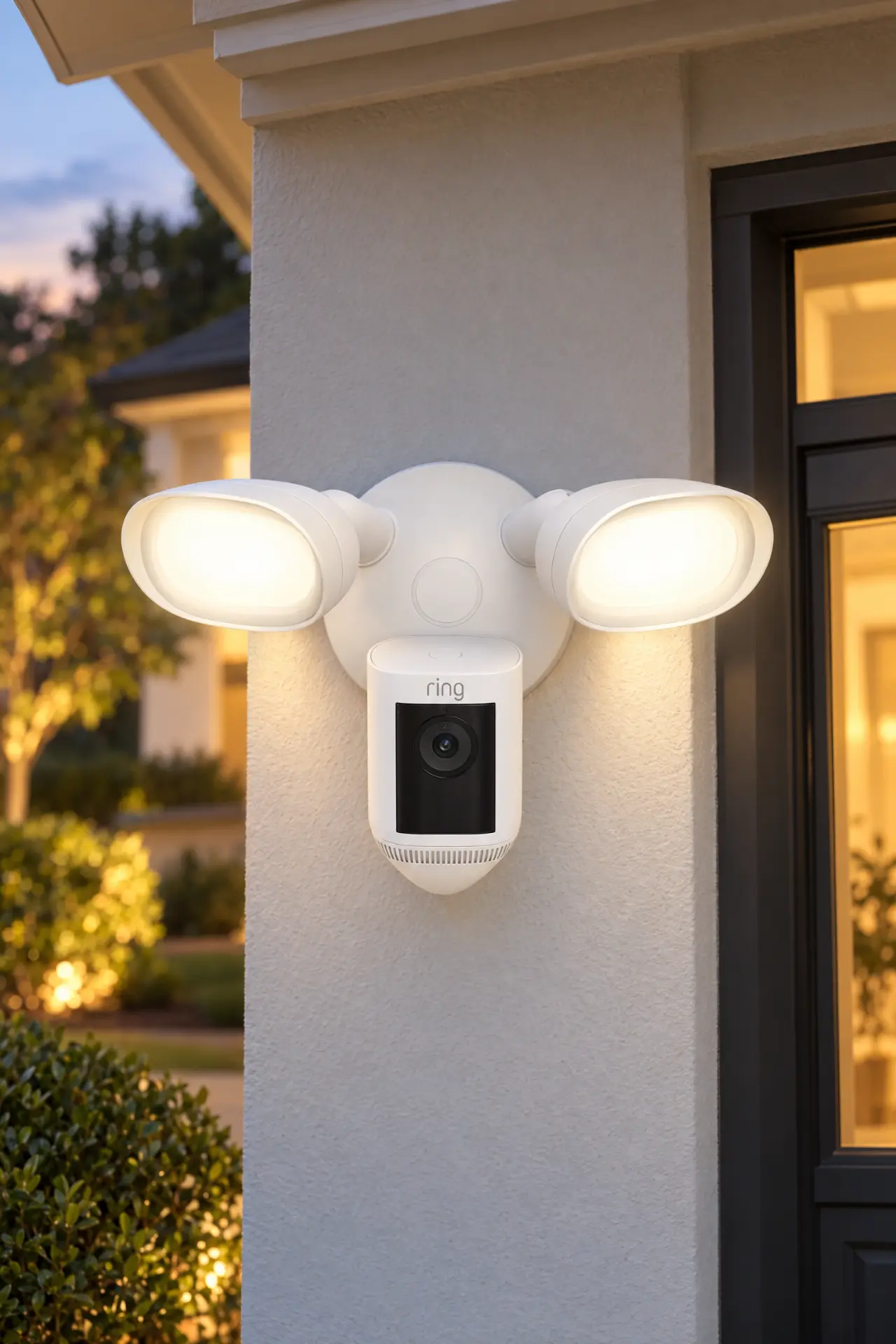
The Outdoor Security Camera That Tracks Intruders From Above
Most security cameras show you that someone is in your yard. The Ring Floodlight Cam Wired Pro shows you exactly where they went, how they got there, and the path they took — from a bird's eye view. That aerial motion tracking map is the feature that separates this camera from every other floodlight cam on the market, and it's the reason Ring charges a premium for the "Pro" version.
But here's the tension with this product: it's genuinely excellent hardware locked behind a mandatory subscription. Without Ring Protect ($4/month or $40/year), you get live view and real-time alerts — but zero video recording, no video history, and no way to review what happened while you were away. That subscription requirement is the single biggest factor in whether this camera is right for you.
After months of use monitoring a driveway and side yard, here's the full honest breakdown.
The Specs
| Spec | Detail |
|---|---|
| Video | 1080p HDR (Ring markets as "HD+") |
| Field of View | 140° horizontal, 80° vertical |
| Floodlights | 2,000 lumens, two LED panels, 3,000K |
| Audio | Two-way talk with noise cancellation |
| Siren | 110dB built-in |
| Motion Detection | 3D Motion Detection with Bird's Eye View |
| Connectivity | Dual-band Wi-Fi (2.4GHz + 5GHz) |
| Smart Home | Alexa built-in, Google Assistant compatible |
| Weather Rating | -5°F to 118°F operating range |
| Power | Hardwired (requires existing electrical junction box) |
| Colors | Black, White |
| Price | $249.99 MSRP, frequently $149.99-199.99 on sale |
What Makes This Camera Worth It
Bird's Eye View is a genuine game-changer. This is the feature that justifies the "Pro" price tag. Using radar-based 3D motion detection, the camera creates an aerial map of your property and tracks exactly where a person or object moved — showing the path as a dotted line on a top-down view of your yard. Instead of watching a 2-minute video trying to figure out which direction someone came from, you glance at the Bird's Eye View and see the entire path in two seconds. Multiple professional reviewers called this the single most useful security camera feature they've tested. Once you have it, going back to a standard motion zone feels primitive.
2,000 lumens lights up your entire yard. These aren't decorative accent lights — 2,000 lumens at 3,000K is genuinely bright. For context, a typical 60-watt bulb produces about 800 lumens. The Ring Floodlight Cam Pro puts out more than double that across two LED panels, covering a wide area with warm white light. The lights activate on motion, on a schedule, or on command through the app. As a pure floodlight — ignoring the camera entirely — this would be a solid outdoor light.
The 110dB siren is a real deterrent. 110 decibels is roughly as loud as a rock concert or a chainsaw. When triggered (manually through the app or automatically via motion rules), it's loud enough to startle anyone and alert your neighbors. Combined with the sudden blast of 2,000 lumens, the siren creates a fight-or-flight response that sends most trespassers running. You can trigger it from anywhere through the Ring app — sitting in your living room or on vacation across the country.
Dual-band Wi-Fi solves the buffering problem. Cheaper Ring cameras only connect on 2.4GHz, which means congestion if you have a lot of smart devices. The Floodlight Cam Wired Pro supports 5GHz, which provides faster, more reliable video streaming with less interference. If your router is within reasonable range of the camera, 5GHz connectivity means smoother live views and faster alert response.
HDR video handles tricky lighting well. The 1080p HDR sensor does a notably good job with high-contrast scenes — a bright driveway with a shadowed walkway, direct sunlight with dark corners. Standard cameras blow out the bright areas or lose detail in the shadows. HDR balances both, which matters because outdoor security cameras face challenging lighting conditions constantly. Night vision with the infrared LEDs is clear and detailed.
Hardwired means no battery anxiety. Unlike Ring's battery-powered cameras, this one is always on, always recording (with subscription), and never needs charging. The constant power connection also enables features that battery cameras can't sustain — continuous 3D radar scanning, instant motion response, and brighter floodlights. You never miss an event because the battery died at 2 AM.
The playback timeline is the best in the business. Multiple reviewers specifically praised Ring's video timeline scrubbing. You can scroll through hours of footage quickly and smoothly, jumping to motion events with color-coded markers. Finding a specific moment is faster and more intuitive than any competitor's app. When you're trying to figure out when a package was delivered or when the neighbor's dog got into your yard, this matters.
Alexa integration is seamless. "Alexa, show me the driveway" pulls up a live view on any Echo Show or Fire TV. Motion alerts can trigger Alexa announcements throughout your house — "Motion detected at the front yard" on every Echo speaker simultaneously. If you're already in the Ring/Alexa ecosystem with a Ring Doorbell or other Ring cameras, this camera slots in perfectly and shares the same app, the same subscription, and the same routines.
The Honest Problems
The subscription is effectively mandatory. Without Ring Protect ($4/month per camera or $10/month for unlimited cameras), you get live view and real-time notifications — but no video recording whatsoever. You can't review what happened 5 minutes ago, let alone last night. No snapshots. No video history. For a $250 camera, that's a hard pill to swallow. The hardware is a one-time cost; the subscription is forever. Over 5 years, you'll pay $200-600 in subscription fees on top of the camera price.
Compare this to competitors: Wyze offers local microSD storage and a cheaper subscription. Google Nest gives you 3 hours of event history for free. Eufy and Arlo offer local storage options that work without any subscription at all. Ring's zero-storage-without-subscription approach is the most restrictive in the industry.
There is no local storage option. This is the bigger issue. If your internet goes down — which often happens during the exact storms and power events when security cameras matter most — the camera cannot record anything. No SD card slot. No local backup. No USB storage. Everything goes to Ring's cloud servers or nowhere. For a hardwired security camera, the lack of any local fallback is a genuine security gap.
It's 1080p, not 2K. Ring's marketing has been confusing on this point. Some listings say "2K" or "HD+," but professional reviewers using test charts confirm this is a 1080p sensor with HDR processing. It produces good-looking video, and the HDR genuinely helps — but if you're comparing spec sheets, competitors like the Wyze Cam Floodlight v2 and Arlo Pro 5 offer true 2K or higher resolution at similar or lower prices. For most security purposes, 1080p is sufficient to identify faces and license plates at reasonable distances. But Ring should be clearer about the actual resolution.
Smart alerts require the subscription. Without Ring Protect Plus ($10/month), you can't filter motion alerts by person, vehicle, animal, or package. You get every motion alert — every car driving past, every cat crossing the yard, every tree branch swaying. The smart filtering that makes motion alerts actually useful is locked behind the higher-tier subscription.
Hardwired installation may require an electrician. The camera replaces an existing outdoor light fixture and connects to your home's electrical wiring. If you have an existing junction box where an outdoor light is already mounted, installation is straightforward — Ring uses color-coded wires and the instructions are clear. But if you need a new junction box installed, or your existing wiring is old or nonstandard, you're calling an electrician. Budget $100-200 for professional installation if you're not comfortable with electrical work.
The motion sensor for lights is less sensitive than the camera. Several owners report that the camera detects motion and sends an alert before the floodlights turn on. It's a minor timing gap, but it means the first second or two of a motion event may be recorded in the dark before the floods illuminate the scene. The camera's night vision fills in, but the floodlight lag is noticeable.
Ring Floodlight Cam Wired Pro vs. the Competition
vs. Wyze Cam Floodlight v2 (~$100): The Wyze costs less than half the price, shoots at a higher resolution, puts out 2,800 lumens (vs. Ring's 2,000), and includes a microSD card slot for local storage. The Wyze subscription (Cam Plus) is $2/month. The Ring wins on Bird's Eye View tracking, build quality, Alexa integration, and app polish. If you're not already in the Ring ecosystem and budget matters, the Wyze is extremely hard to beat on value.
vs. Google Nest Cam with Floodlight (~$280): Nest offers person, vehicle, and animal detection without a subscription, plus 3 hours of free event video history. It integrates with Google Home instead of Alexa. The Ring wins on Bird's Eye View tracking and the siren (Nest doesn't have one). If you're a Google Home household, Nest is the natural choice. If you're an Alexa household, Ring is.
vs. Arlo Pro 5 Floodlight (~$250-300): Arlo offers true 2K resolution, a wider color gamut, and optional local storage. The subscription ($3-10/month) is competitive with Ring's pricing. Arlo's app is solid but not as polished as Ring's. The Ring wins on Bird's Eye View and Alexa integration. Arlo wins on resolution and storage flexibility.
vs. Eufy Floodlight Cam 2 Pro (~$200-250): Eufy's biggest advantage is local storage — no subscription required for video recording. It offers 2K resolution and good smart detection. The trade-off is a less polished app experience and weaker smart home integration. If you refuse to pay a monthly subscription on principle, Eufy is your best option.
Who Should Buy This
Homeowners already in the Ring/Alexa ecosystem. If you have a Ring Doorbell, Ring Alarm, or multiple Alexa devices, this camera integrates seamlessly. One app, one subscription covering all your Ring cameras, and Alexa routines that tie everything together. Front door Ring Doorbell + backyard Floodlight Cam Pro is the classic Ring security setup.
Anyone who wants the Bird's Eye View tracking. No other consumer security camera offers this feature. If tracking exactly where someone walked across your property matters to you — and for security purposes, it absolutely does — this is the only option.
Homeowners with existing outdoor light fixtures. If you already have a junction box and an outdoor light you'd replace anyway, installation is a 30-minute project. You're upgrading a dumb floodlight to a smart security system.
Who Should Look Elsewhere
If you refuse to pay a monthly subscription, the Ring Floodlight Cam Wired Pro makes no sense. Without Ring Protect, you're paying $250 for a live-view-only camera with floodlights. Look at Eufy or Arlo's no-subscription models.
If you need reliable recording during internet outages, Ring's cloud-only approach is a dealbreaker. Wyze with a microSD card or Eufy with local storage will keep recording when your Wi-Fi goes down.
If resolution is a priority, competitors offer 2K and 4K options at similar prices. Ring's 1080p is adequate for most security use, but it's not competitive on the spec sheet.
If you're a Google Home household, the Nest Cam with Floodlight is the natural fit. Ring's Alexa integration is excellent, but its Google Assistant support is basic by comparison.
The Verdict
The Ring Floodlight Cam Wired Pro is the best outdoor security camera for people already invested in Ring and Alexa — and the Bird's Eye View tracking is a feature no competitor matches. The 2,000-lumen floodlights, 110dB siren, and dual-band Wi-Fi round out a genuinely capable security package.
But the mandatory subscription with zero local storage is a real weakness. You're not just buying a camera — you're signing up for a recurring bill that the camera literally can't function without for anything beyond live viewing. That subscription dependency, combined with 1080p resolution in a market moving to 2K and 4K, keeps this from being a perfect recommendation.
At $249.99 it's a solid buy for Ring ecosystem users. At $149.99-199.99 on sale, it's a strong value. Just factor in $40-100/year in subscription costs when you're calculating the true price.
Deal tip: The Ring Floodlight Cam Wired Pro drops to $149.99-179.99 during Prime Day (July), Black Friday, and Ring's own seasonal sales. At $149.99, it's an easy recommendation even with the subscription cost. Set a price alert — Ring products see some of the deepest discounts in the smart home category during major sale events. The white version tends to be more readily available during sales.
The Verdict
Ring's best outdoor security camera — Bird's Eye View tracking, 2,000-lumen floodlights, and a 110dB siren in one hardwired package. Worth buying if it fits how you'll actually use it.
This post contains affiliate links. If you buy through one, I may earn a commission at no extra cost to you.