
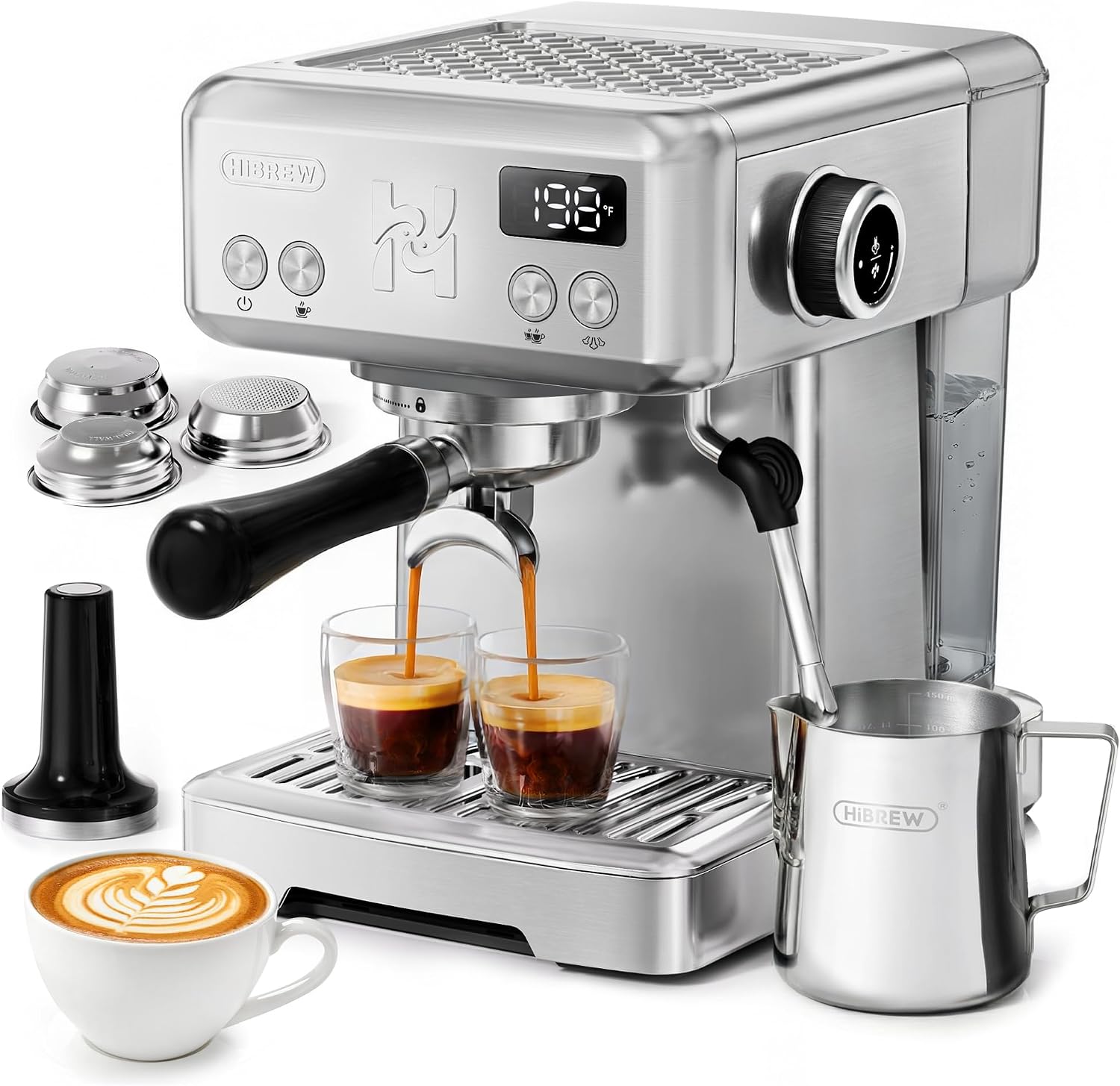
HiBREW H10 Espresso Machine Review: Commercial Features at a Budget Price
I'll be honest — when I first came across the HiBREW H10, I was skeptical. A semi-automatic espresso machine with a 58mm portafilter, PID temperature control, and a real steam wand for under $200? That sounds like the kind of deal that's too good to be true. But after digging into the specs, reading what barista communities are saying, and comparing it head-to-head against machines costing two and three times as much, I'm genuinely impressed.
This machine is challenging what we thought was possible at this price point.
Quick Specs
| Feature | Details |
|---|---|
| Portafilter Size | 58mm (commercial standard) |
| Pump Pressure | 20 bar (9 bar optimal extraction) |
| Brew Temperature | 90°C – 95°C, adjustable in 1°C steps |
| Steam Temperature | 125°C – 150°C, adjustable |
| Pre-Infusion | 0 – 10 seconds, adjustable |
| Water Reservoir | 1.2L, removable |
| Construction | Stainless steel body, aluminum internals |
| Pressure Gauge | Yes, front-mounted |
| Weight | ~15 lbs |
| Dimensions | Compact countertop footprint |
| Warranty | 1-year limited |
| Regular Price | $219.99 |
| Sale Price | ~$187 |
What Makes This Machine Stand Out
Commercial-Grade 58mm Portafilter
This is the headline feature and the one that separates the H10 from nearly everything else at this price. Most budget espresso machines use 51mm or 54mm portafilters. The 58mm size is what you'll find on commercial machines at your local coffee shop, and it matters for a few reasons: more even extraction across the coffee puck, a wider selection of aftermarket accessories (baskets, tampers, bottomless portafilters), and a heavier, more substantial feel during your workflow.
The included portafilter weighs 535 grams and feels like it belongs on a machine twice the price. HiBREW also includes a solid metal tamper with a wooden handle — a noticeably better accessory than what ships with the Breville Barista Pro at $500+.
PID Temperature Control
Temperature stability is one of the biggest factors in consistent espresso. The H10 gives you PID-controlled brew temperature adjustable from 90°C to 95°C in single-degree increments. That's a level of precision you typically don't see below the $400–$500 range. The steam temperature is separately adjustable from 125°C to 150°C.
There's also an automatic cool-down feature: after steaming milk, the machine can dispense water to bring the brew group back down to proper extraction temperature. The display tells you when it's ready. This kind of "temperature surfing" automation is a real quality-of-life upgrade for back-to-back drinks.
Adjustable Pre-Infusion
Pre-infusion — gently wetting the coffee puck before full pressure hits — reduces channeling and improves extraction evenness. The H10 lets you adjust this from 0 to 10 seconds. Many machines at double the price either have fixed pre-infusion or none at all.
Front-Mounted Pressure Gauge
A real pressure gauge on the front lets you see exactly what's happening during extraction. This is invaluable when you're dialing in your grind size — if pressure is too high, you know to go coarser; too low, go finer. It takes the guesswork out of one of the trickiest parts of home espresso.
Steam Wand
The single-hole steam wand rotates freely and produces enough power to texture milk to 60°C in about 50–60 seconds. With practice, you can produce microfoam suitable for latte art. It's not going to rival a heat exchanger or dual-boiler machine's steam power, but for a single-boiler at this price, it's more than capable.
The Pros
- 58mm commercial portafilter — the biggest differentiator at this price; huge aftermarket accessory ecosystem
- PID temperature control with 1°C precision for both brew and steam
- Adjustable pre-infusion (0–10 seconds) for better extraction
- Pressure gauge for real-time feedback while pulling shots
- Excellent included accessories — heavy portafilter, wooden-handled tamper, stainless milk jug
- Stainless steel construction — not a plastic shell with chrome paint
- Auto cool-down after steaming eliminates manual temperature surfing
- Shot timer on display for tracking extraction time
- Cold brew espresso mode (25°C setting) for iced drinks
- Compact footprint that works in small kitchens
The Cons
- Small, shallow drip tray — needs emptying every 2–3 shots, and water can splash onto the counter during longer pours
- Group head cleaning — the shower screen and group head collect grounds and require regular brushing; not as easy to maintain as some competitors
- Single boiler — you can't brew and steam simultaneously; there's a wait between pulling a shot and steaming milk (mitigated by the auto cool-down feature)
- Learning curve — this is a semi-automatic machine; you need a separate grinder, and dialing in takes patience
- Brand recognition — HiBREW doesn't carry the name recognition of Breville, DeLonghi, or Gaggia, which can make warranty service and parts sourcing less predictable
- Limited color options — currently available in silver/stainless; no matte black or white options
- Settings adjustment requires button combinations rather than a menu — not intuitive without watching a tutorial
Who Should Buy This
The HiBREW H10 is ideal if you're serious about learning real espresso but don't want to drop $500+ on your first machine. It gives you the same fundamentals — proper portafilter size, temperature control, pre-infusion, a real steam wand — that you'd use on a professional setup. If you already own a decent burr grinder (or plan to buy one), this machine will reward your investment.
It's also a smart pick if you're upgrading from a Nespresso or a basic drip maker and want to understand what makes specialty espresso different. The pressure gauge and adjustable settings teach you what's actually happening during extraction, instead of hiding everything behind a one-button interface.
Who Should Look Elsewhere
If you want a completely hands-off experience — push a button and get a latte — this isn't your machine. Look at a superautomatic like the DeLonghi Rivelia or the Ninja Luxe Café Premier instead.
If you pull more than 4–5 drinks back-to-back regularly (think: entertaining or a busy household), the single boiler and small drip tray will slow you down. A heat exchanger or dual-boiler machine would be a better fit, though you're looking at $700+ minimum.
And if brand reputation and long-term parts availability are your top priority, the Breville Bambino Plus or Gaggia Classic Pro are safer bets — they've been on the market longer and have larger service networks, though both cost significantly more for fewer features.
The Competition
| Machine | Price | Portafilter | PID | Pre-Infusion | Pressure Gauge |
|---|---|---|---|---|---|
| HiBREW H10 | ~$187 | 58mm | Yes | Adjustable | Yes |
| Breville Bambino Plus | ~$400 | 54mm | No | Auto only | No |
| Gaggia Classic Pro | ~$450 | 58mm | No (mod available) | No | No |
| Breville Barista Express | ~$600 | 54mm | Yes | Auto only | Yes |
On paper, the H10 wins on features at a fraction of the cost. The trade-off is brand maturity, build refinement, and long-term support.
The Verdict
The HiBREW H10 is one of the most feature-dense espresso machines I've seen at any price, let alone under $200. A 58mm portafilter, PID control, adjustable pre-infusion, a real pressure gauge, and a capable steam wand — it checks boxes that machines at $400–$600 struggle to match.
Is it perfect? No. The drip tray is too small, the cleaning routine requires attention, and you're betting on a newer brand. But the espresso it produces — with proper technique and a good grinder — competes with machines costing two to three times as much.
If you're willing to learn the craft and you want a machine that grows with you instead of limiting you, this is an exceptional value.
Rating: 4/5 — Outstanding feature set and value held back only by minor build refinements and brand maturity.
Deal Tip 💡
At the current sale price of ~$187 (down from $219.99), you're getting a feature set that rivals the $450–$600 range. Put the savings toward a quality burr grinder — that's the single biggest upgrade you can make for your espresso quality. A machine this capable deserves fresh, precisely ground beans.
The Verdict
A semi-automatic espresso machine with a commercial-grade 58mm portafilter, PID temperature control, and professional steam wand — all for under $200. It punches way above its price class. Worth buying if it fits how you'll actually use it.
This post contains affiliate links. If you buy through one, I may earn a commission at no extra cost to you.