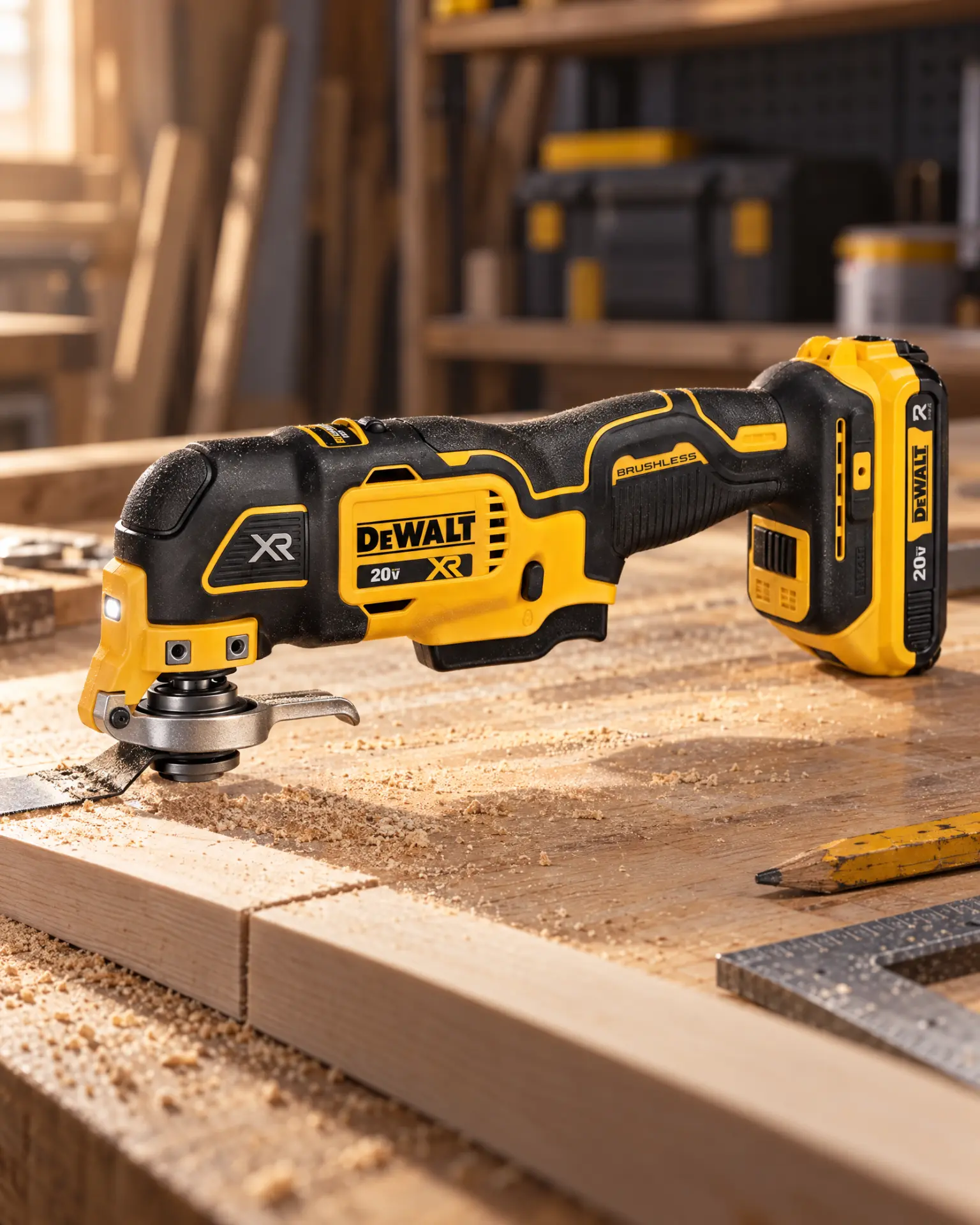
The One Tool That Replaces Five Others
If you've never used an oscillating multi-tool, here's the simplest way to explain it: imagine one power tool that cuts through wood, sands tight corners, scrapes old paint, removes grout, undercuts door jambs for new flooring, and slices through PVC pipe — all by swapping the blade at the end. That's what an oscillating tool does. The tip vibrates back and forth thousands of times per minute in a tiny arc, and depending on which attachment you snap on, it becomes a saw, a sander, a scraper, or a grinder.
The DEWALT DCS356C1 is the best-selling cordless oscillating tool on the market — over 14,400 ratings on Amazon with a 4.8 out of 5 stars. It's the one contractors reach for on job sites and the one DIYers buy when they realize a circular saw can't cut a baseboard flush against a wall. Once you own one, you'll wonder how you ever did home projects without it.
The Specs
| Spec | Detail |
|---|---|
| Motor | Brushless |
| Speed | 0-20,000 OPM (oscillations per minute) |
| Speed Settings | 3 presets + variable-speed trigger |
| Oscillation Arc | 3.2° |
| Battery | 20V MAX Lithium-Ion (1.5 Ah included) |
| Weight | 2.33 lbs (bare tool) |
| Quick-Change | Tool-free blade swap system |
| LED Light | Built-in work light |
| Warranty | 3-year limited, 1-year free service, 90-day money-back |
| Price | ~$159 retail, frequently $99-129 on sale |
What's in the Kit
- DCS356 Oscillating Multi-Tool
- 1.5 Ah 20V MAX battery
- DCB107 charger
- Wood cutting blade
- Wood/metal cutting blade
- Universal accessory adapter (fits most brands' blades)
- Carrying bag
Why This Is the Oscillating Tool to Buy
The brushless motor is a big deal. Brushless motors deliver up to 57% more runtime than brushed motors on the same battery. They also run cooler, last longer, and deliver more consistent power throughout the battery charge. At this price point, a brushless oscillating tool is a genuine upgrade over cheaper brushed alternatives from Ryobi and Craftsman.
Three-speed presets plus variable trigger give you real control. The 3-speed selector lets you lock in low (for delicate sanding), medium (for general cutting), or high (for aggressive material removal). On top of that, the variable-speed trigger lets you feather the speed within each range. This matters because different materials need different speeds — sanding wood at 20,000 OPM will burn it, while cutting through a nail at 8,000 OPM will take forever. The dual control system lets you match the tool to the task precisely.
At 2.33 pounds, it's one of the lightest in its class. The Milwaukee M18 FUEL weighs 3.1 lbs. The Makita XMT04ZB weighs 3.7 lbs. The DEWALT at 2.33 lbs is the lightest premium cordless oscillating tool you can buy. For a tool you often use overhead — cutting ceiling drywall, trimming crown molding, sanding cabinets — every ounce matters. Less weight means less arm fatigue during long projects.
The Quick-Change system makes blade swaps fast. Pull the lever, pop off the old blade, snap on the new one. No hex wrenches, no fumbling with screws. When you're switching between cutting wood, sanding a surface, and scraping old paint in the same project, fast blade changes keep your momentum going. The included universal adapter also lets you use blades from Bosch, Fein, Makita, and other brands — you're not locked into DEWALT-only accessories.
The LED work light is more useful than you'd think. Cutting into a wall cavity? Trimming under a cabinet toe kick? Sanding inside a closet? The built-in LED illuminates exactly where the blade meets the material. It sounds like a minor feature until you're working in a crawl space at 7 PM and can actually see what you're cutting.
It runs on the DEWALT 20V MAX battery platform. If you already own a DEWALT drill, impact driver, circular saw, or any other 20V MAX tool, every battery you own works in this oscillating tool. The kit includes a 1.5 Ah battery, but snap in a 5.0 Ah battery from your drill and you'll get significantly more runtime.
What This Tool Actually Does — 10 Real Projects
If you're not sure whether you need an oscillating tool, here's what homeowners actually use it for:
-
Undercutting door jambs for new flooring. Lay a piece of flooring next to the door frame, set the oscillating tool flat on it, and cut the jamb flush. The flooring slides underneath for a clean, professional look. No chisel needed.
-
Cutting baseboards and trim in place. Need to remove a section of baseboard without tearing out the whole thing? Plunge cut straight down through it right where it sits on the wall.
-
Removing grout between tiles. Snap on a grout removal blade and run it along the grout lines. Removes old grout for re-grouting without damaging the surrounding tiles.
-
Cutting drywall for outlets and switches. Draw the outline, plunge the blade in, and cut the opening. No pilot hole needed. Clean, precise cuts that fit electrical boxes perfectly.
-
Sanding in tight corners. The triangular sanding pad reaches into corners, along edges, and into details that no orbital sander or belt sander can touch.
-
Scraping old paint and adhesive. Snap on a rigid scraper blade and remove old paint, carpet adhesive, caulk, or dried thin-set mortar from floors, walls, and fixtures.
-
Flush-cutting nails and screws. Need to remove a nail that's sticking up from a subfloor? Cut it flush with a metal-cutting blade. Done in seconds.
-
Cutting PVC and copper pipe in tight spaces. When a pipe is against a wall and a hacksaw won't fit, the oscillating tool cuts it from the side. Plumbers use these constantly.
-
Trimming window and door shims. After shimming a window or door frame, cut the shims flush with the wall in one pass. No utility knife required.
-
Removing old caulk around tubs and windows. The scraper blade slices through old silicone and latex caulk faster than any razor blade, and without gouging the surface underneath.
The Honest Downsides
The included 1.5 Ah battery is small. For light projects — cutting a few door jambs, sanding a small piece of furniture — the 1.5 Ah battery is fine. For extended cutting sessions, it drains in 15-25 minutes depending on the material and speed setting. If you already own DEWALT 20V tools with larger batteries (3.0, 4.0, or 5.0 Ah), use those instead. If you don't, budget for a larger battery purchase down the road.
The included blades are just starter blades. The two cutting blades in the kit get the job done, but they're not premium quality. After a few projects, you'll want to invest in a blade set — a good 10-15 piece set from DEWALT or a compatible brand runs $25-40 and includes wood blades, bi-metal blades for nails, sanding pads, scrapers, and grout removal blades. The real versatility of the tool opens up when you have the right blade for each job.
The blade change mechanism can stick when dirty. Multiple users report that after heavy use with drywall dust or wood chips, the Quick-Change lever gets stiff and requires extra force. A quick blast of compressed air or a wipe-down fixes it, but it's an annoyance during a messy job.
3.2° oscillation arc is narrower than competitors. The Milwaukee M18 FUEL has a 4.2° arc, which means it cuts more aggressively per oscillation. In practice, the DEWALT cuts slightly slower through thick hardwood and metal than the Milwaukee. For most DIY projects, you won't notice the difference. For all-day professional cutting, the wider arc matters.
Vibration is manageable but present. Oscillating tools vibrate by design — that's how they work. The DEWALT handles vibration well for its class, but it's not in the same league as the Makita, which uses an active counterbalance system that reduces vibration by up to 85%. For occasional weekend projects, the DEWALT's vibration is fine. For professional daily use, consider the Makita if hand fatigue is a concern.
DEWALT DCS356 vs. the Competition
vs. Milwaukee M18 FUEL 2836-20 (~$199-249): Milwaukee cuts faster (4.2° arc vs 3.2°), has variable-speed dial instead of 3 presets, and includes an auto-load feature that increases speed under cutting pressure. But it's heavier (3.1 lbs vs 2.33 lbs), more expensive, and the blade change system is slower. DEWALT wins on weight, value, and ease of use. Milwaukee wins on raw cutting speed and control. Pro Tool Reviews scored Milwaukee 9.6/10 vs DEWALT 9.2/10 — close race.
vs. Makita XMT04ZB (~$169-199): Makita's standout feature is its anti-vibration technology (AVT), which reduces vibration up to 85%. For professionals using an oscillating tool for hours daily, this is a significant comfort advantage. But the Makita weighs 3.7 lbs — nearly 60% heavier than the DEWALT — and the Starlock blade system, while excellent, limits you to Makita/Bosch-compatible blades. DEWALT wins on weight and blade flexibility. Makita wins on vibration control.
vs. Ryobi PCL430 (~$79-99): Ryobi's budget oscillating tool is brushed (not brushless), doesn't include a battery, and lacks the precision speed control of the DEWALT. If you already own RYOBI ONE+ batteries and only need an occasional oscillating tool for light tasks, it's a decent budget pick. But the DEWALT's brushless motor, better speed control, lighter weight, and included battery make it worth the step up for anyone who'll use it more than twice a year.
Who Should Buy This
Homeowners doing their own renovations. If you're installing new flooring, updating trim, replacing tile, or doing any remodeling work, this is the tool that makes impossible cuts possible. Undercutting door jambs alone justifies the purchase.
DIYers who don't own an oscillating tool yet. This is the best first oscillating tool you can buy. The kit includes everything you need to start — tool, battery, charger, blades, and bag. The brushless motor and 3-speed control mean you won't outgrow it.
Anyone in the DEWALT 20V battery ecosystem. If you own DEWALT drills, drivers, or saws, your batteries already work in this tool. Buy the tool-only version (DCS356B, ~$99-119) and save money.
Small business owners and property managers. Quick repairs, trim work, paint scraping, caulk removal, pipe cutting — this tool handles the random fix-it jobs that come up in commercial and rental properties without dragging out five different tools.
Who Should Look Elsewhere
If you're a professional contractor cutting all day, the Milwaukee M18 FUEL cuts faster and the Makita reduces hand fatigue with its anti-vibration system. The DEWALT is excellent for moderate use but isn't the top pick for 8-hour daily cutting sessions.
If you just need to sand furniture, a random orbital sander is faster and smoother for large flat surfaces. The oscillating tool's sanding pad is for tight corners and detail work, not replacing a full-size sander.
The Verdict
The DEWALT DCS356C1 is the oscillating multi-tool I recommend for homeowners and DIYers — and it's not close at this price point. At 2.33 pounds, it's the lightest premium cordless option. The brushless motor delivers 57% more runtime than brushed competitors. The 3-speed control with variable trigger gives you precision for everything from delicate sanding to aggressive wood cutting. And the 4.8-star rating across 14,400+ reviews isn't an accident — this tool earns it.
The included battery is small and the included blades are basic, but those are $30-50 upgrades that don't diminish the tool itself. Once you own an oscillating tool, you'll reach for it on every project and wonder how you ever worked without one.
Deal tip: The DCS356C1 kit drops to $99 during Prime Day and Black Friday — that's a brushless oscillating tool with battery, charger, blades, and bag for under $100. At that price, it's a steal. The tool-only version (DCS356B) runs $99-119 regularly and is the smart buy if you already have DEWALT 20V batteries. Check Amazon, Home Depot, and Acme Tools for the best current price.
The Verdict
The DEWALT DCS356C1 is the oscillating multi-tool I recommend for homeowners and DIYers — and it's not close at this price point. At 2.33 pounds, it's the lightest premium cordless option. The brushless motor delivers 57% more runtime than brushed competitors, and the 3-speed control with variable trigger handles everything from delicate sanding to aggressive wood cutting. The included battery is small and the included blades are basic, but those are $30-50 upgrades that don't diminish the tool itself — the 4.8-star rating across 14,400+ reviews is earned.
This post contains affiliate links. If you buy through one, I may earn a commission at no extra cost to you.